

bare(ish) theory
aura farming, the 'bare face' movement and being fashionably feral

It is 11:36am. I am in the office. My face is bare(ish).
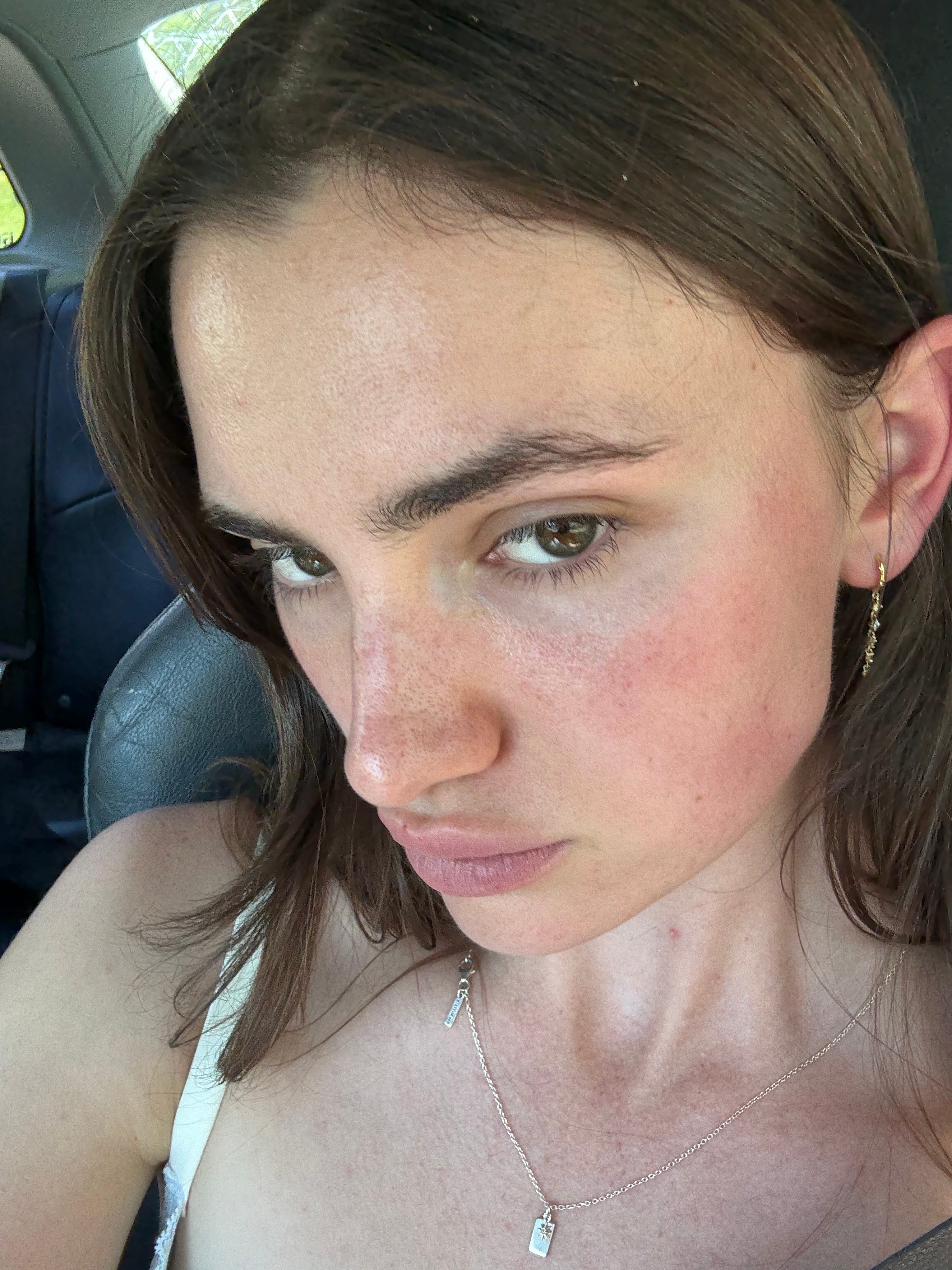
This means I have a pimple on my left cheek and my undereye bags are very visible. Only a carefully applied lip liner and some military-grade brow gel adorn my face. 15 year old me (2016 era) would be absolutely mortified that at 24 I’d be happily twiddling my thumbs in a capitol city, with essentially ‘no makeup’ on. But this is no mistake. This is a very curated cool-girl performance.
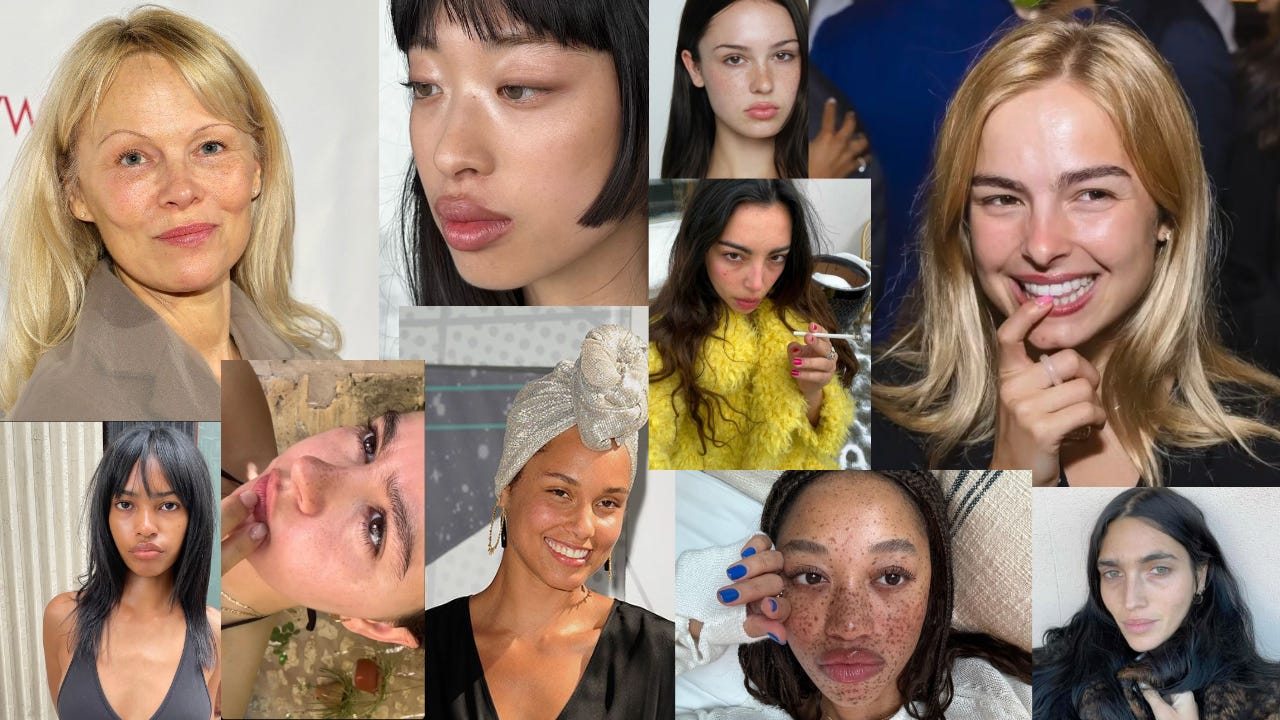
It began approximately 2 years ago when Enya Umanzor began live-posting her mono-brow and bare(ish) selfies. And then Emma Chamberlain cut her hair. I stopped wearing foundation, and then I stopped wearing contour, blush, etc. etc > my makeup ‘collection’ becoming a ‘bag’ diluting into a re-used pencil case. But this shift also came alongside my continual spiral into the wellness/herbalist zeitgeist (through my health science degree). the more I practiced ‘wellness’ rituals (yoga, meditation, dry brushing etc etc etc), the more bare I found myself.
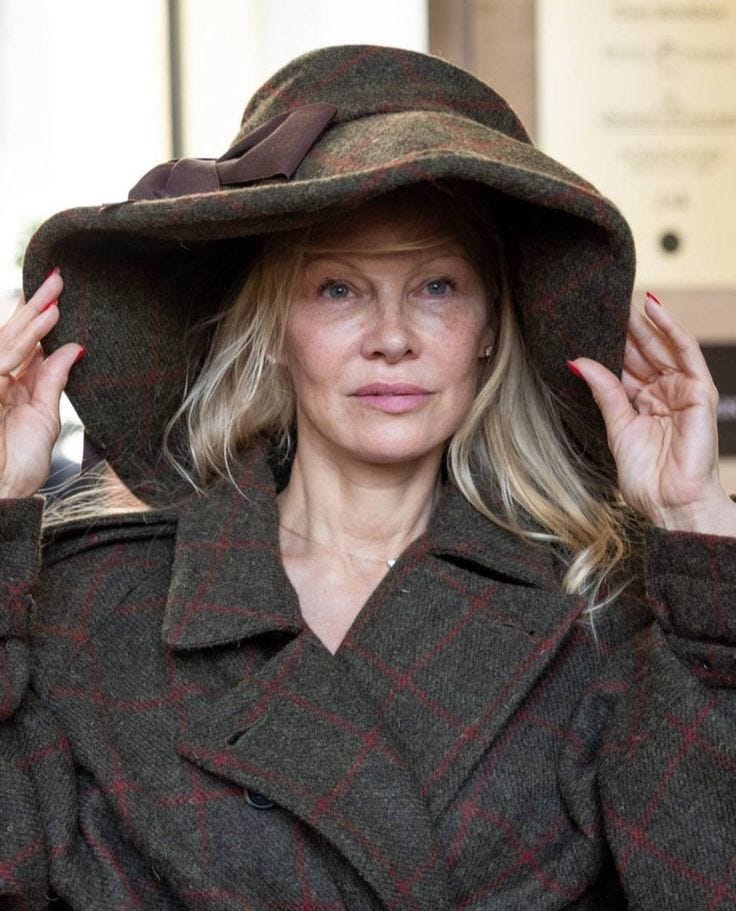
During September 2023, Pamela Anderson debuted her bare(ish) face at Vivienne Westwood’s S/S 2024 show. It wasn’t necessarily the first time, but it was definitely a poignant fashion moment. Daniela Armas (who identified Alicia keys as the ‘original no-makeup poster child’ *circa 2016) noted that this ‘shift mirrored her career arc—from bombshell to minimalist sophisticate’.
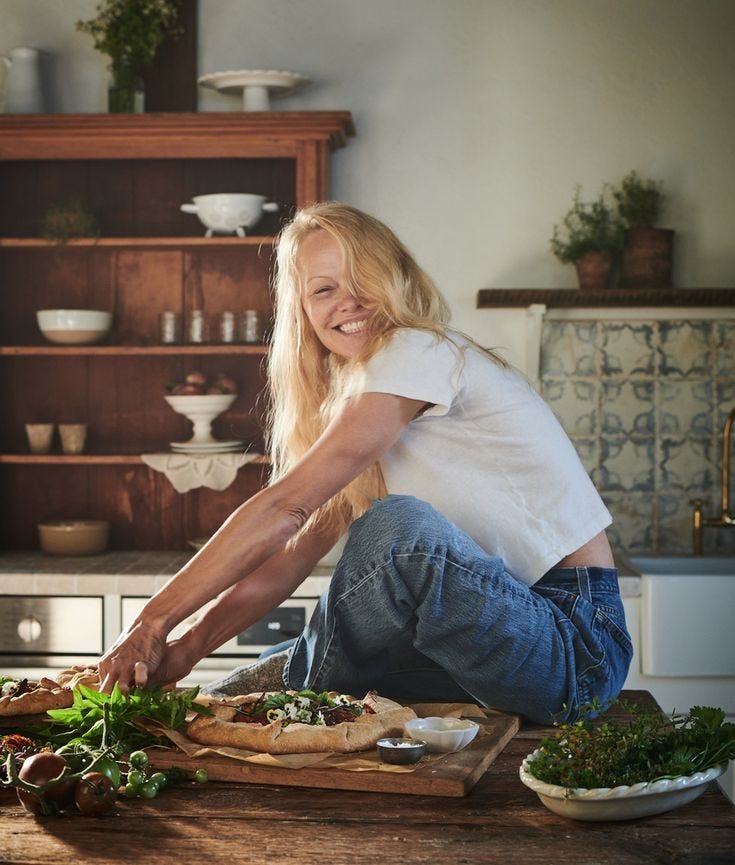
Suddenly Pamela became an emblem for wellness-oriented peri-menopausal women on reddit. She has chickens, a garden and a substack dedicated to slow living.
Being a partially retired fashion/runway model means that I have always had a bit less makeup on my face (in comparison to campaign & e-comm style work). And in fact when I have glam done it freaks me the HELL OUT. I have some sort of internal meltdown (and self-image deconstruction) it is very intriguing. Because, as we see with Pamela A, Enya Umanzor, Addison rae, Mazzy Joya, Emma Chamberlain, Gabbriette… a very clear socio-economic, ‘intelligence assuming’ and health-realm message operates behind this curtain of little-no makeup. Otherwise it wouldn’t be the norm in high fashion settings… right?
Being bare-faced is not an obvious spectacle, not even being outwardly aspirational (as bare face is arguably free), but it is still secretly (or not so secretly) performing. That is why I am referring to this as bare(ish). It isn’t completely bare and it also isn’t the previously known ‘no-makeup makeup’. It isn’t a ‘radical’ choice or promoted as anti-makeup. Instead it arises as a curious secret third thing. A very distinct performance and lifestyle signifier.
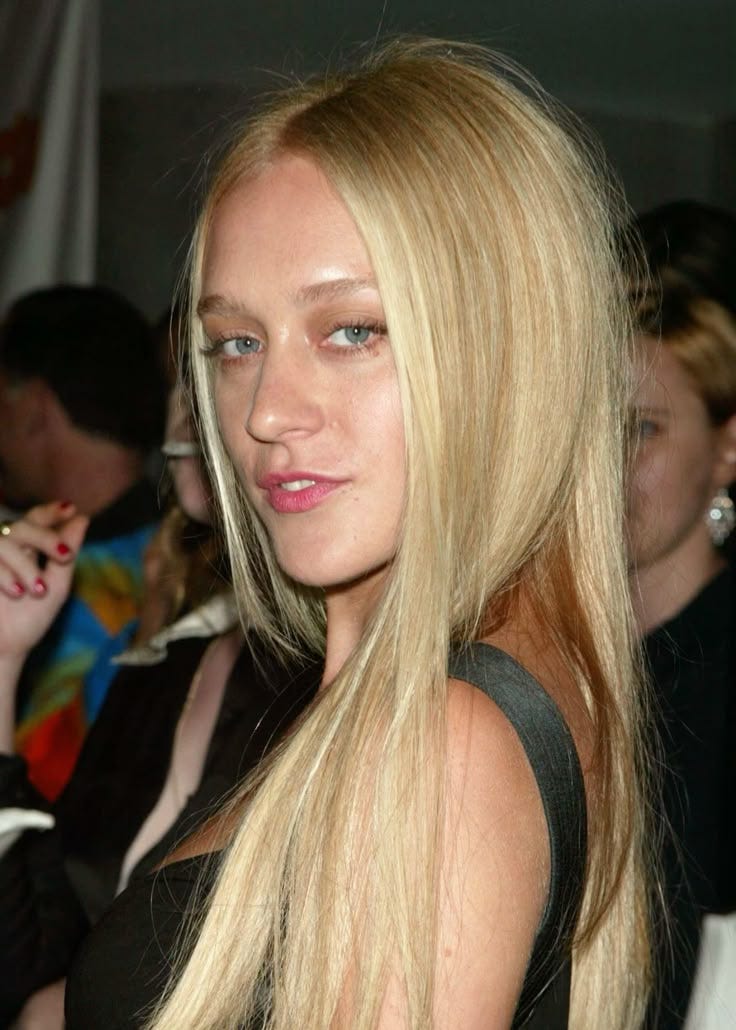
Daniela Armas articulates this perfectly;
‘So while this may look like renunciation, neither woman is abandoning beauty. Rather, they’re offering a version that feels tasteful, current, and deliberate. That intentionality isn’t anti-performative—it’s performance at the highest level. And that’s not a knock. It’s a nod to their taste, instincts, and ability to navigate the zeitgeist. The looks land precisely because they’re curated. Miss that, and you miss their genius entirely.’
In my 2026 ‘wellness trend predictions’ I noted some ‘societal body image changes’ (that related to ai, body modification culture and ozempic). I stand by this - the counter culture to perfection is imperfection, it is Wabi Sabi, the transient reality of beingness. The pendulum always swings. Ai cannot make someone look realistically barefaced (yet?) it cannot capture the slightest, most unique features like the lacunae in your eye. AI ‘photos’ send tingles up my spine as if I am navigating a haunted house. They cannot replicate the flushing of your cheeks in the afternoon sun. gabi abrão explores this in her patreon episode ‘fashionably, feral February’, mentioning an almost ‘bare’ approach to menstruation, sex and living, recounting the use of a black towel to free bleed into. She highlights this same human-being vs. ai age distinction > our bareness is what reminds us that we are human. My bare(ish) performance is the embodiment of my fashionably feral nature.
Prior to this, Zeynab Mohamed spotted ‘bare(ish)’ in 2024. Her piece ‘I Like Makeup A LOT. But Am I Over Wearing It?’ identifies how the endorsement of beauty trends and aesthetics inadvertently ‘propagate a singular concept of beauty, one that excludes many from feeling truly represented or celebrated’. Zeynab caught the rising bare-face shift correlating it to a sense of ‘beauty burnout’, feeling exhausted, moving toward active experimentation > how makeup can be used in ways that aren’t necessarily ‘self-optimizing’ or seeking perfection. Perhaps this is re-occurring now, as we navigate a heavily saturated beauty market. We can’t help but to begin to reject it.
So this duality of bare-faceness, seen in Pamela Anderson and Alicia Keys is now seen in the aesthetic trends possessing many gen-z babe-fluencers and young women, (such as me). Young women with carpal tunnel, a scrolling problem and a lip-liner addiction. I am wearing less makeup because I want to look like me. As much as possible. And right now that looks like nutritional awareness, rolling around on may yoga mat, taking several herbal and flower remedies, regular facial massage and a really good lip product. And taking selfies while I do it.
This individualism, ai-human and escapism/beauty burnout may be a cultural shift that aligns with Walter Benjamin’s Aura theory. Which Cricket Guest explores amazingly here (pls click here to see her chart):
“We exist in a culture that progressively moves more and more towards low aura, and high exhibition value, so this means the bench mark of where mediums/people are positioned within this chart is constantly moving, as culture shifts.”
Walter Benjamin was considering: What happens to meaning, value, and experience when art can be endlessly reproduced? ‘Aura’ being a spectrum, between low and high. The higher the aura the less reproducible, the lower the aura, the easier it is to replicate and recreate.
Being more difficult to replicate leads to higher ritual value, as the meaning arises through context rather than visibility. Cricket aligns this with the ‘model’ and ‘influencer’ tropes, highlighting how refined taste and contextual awareness of fashion intersect [here]. So using Cricket Guest’s chart and Benjamin’s theory;
Bare(ish)= high aura, lower exhibition [high ritual]
Full Glam = low aura, higher exhibition [low ritual]
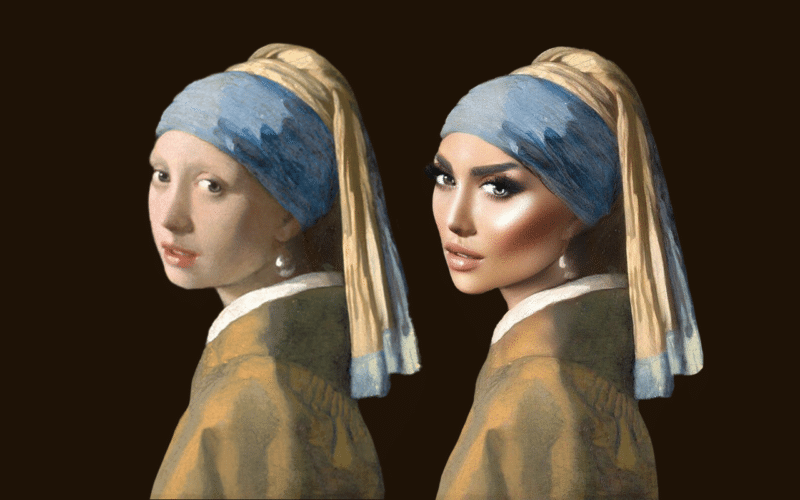
Full glam is seemingly easier to replicate through AI, editing software and filters - making it easier to circulate. More consumption and consumerism is required, essentially embodying ‘instagram face’. You can [almost] instantaneously look the way you wish to with glam, so long as you can afford the products, filler, filter, facetune etc. It is of course very complex, as being able to execute a full-face of makeup is a distinct skill. But the replication of the general ‘appearance’ (aura) of a full face can be sort of effortless, as it places a veil over your individual features, mimicking hyper-feminine, mass produced features.
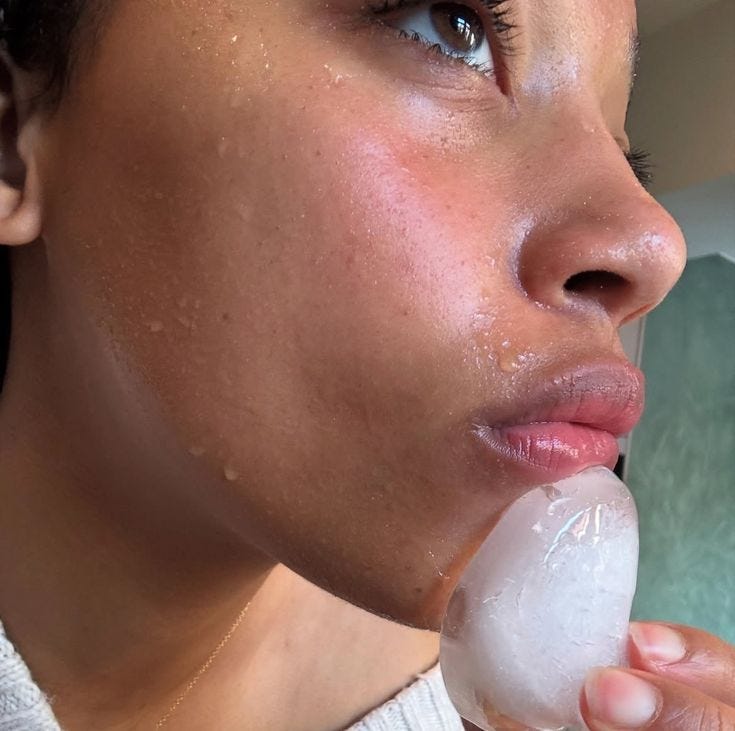
Bare(ish) is potentially higher in ritual, it requires a different sort of consumption. It usually involves an aspect of wellness, health and nutrition (maintaining your hair, skin and nails for example). The shift seen in Pamela’s reception post-bare face debut, with her image quickly becoming one with wellness, health and the reclamation of womanhood reflects a part of this. She has oscillated from high exhibition value, to lower exhibition. It is a higher ritual to be comfortable in ones skin. It is higher ritual to hold your own humanness as we decent further and further into the human-tech hybrid. And because of this it is lower exhibition value, because it isn’t as easy to replicate. I cannot ‘look like’ Pamela Anderson with no makeup without: significant strange makeup, filters, lighting, photoshop > the capacity to replicate someone else’s bare features is extremely difficult. Because the foundation is (usually) an individuals very specific features.
There is a lot more that could be said on this topic: how bare(ish) interplays with socio-cultural narratives, what it signals about politics (brat ‘no makeup makeup’ vs. clean girl vs tradwife) and what it means for femme presenting individuals in general. This is more or less connecting a few dots.
I find it really interesting how consistently I am seeing this narrative arise, and I want to end with this quote that has been floating around my brain from Rachael Akhidenor’s February issue “Now it seems the performance has shifted. We’re no longer curating perfection. We’re curating truth, or at least something closer to it.”
Thank you for reading <3
Caitlin xx
Rather ironically, next week I will follow this up with specific naturopathic guidance for bare(ish) cultivation. Ways of formulating and enhancing your ‘self skin’ comfort through ritualised, traditional modes of ‘medicine’. It will list ways of becoming more ‘bare(ish)’ beyond makeup. Subscribe if you’d like this to land gracefully in your inbox.
I hadn’t thought about it in this way - low exhibition value vs high. And there are barriers in place to participate in a more bare faced look, though. Having clear even toned skin and desirable facial features make it easier to embrace. Thinness even, too. If you don’t already have defined bone structure, is aura devalued? Wellness, access to treatments and the genetic lottery - or altered - all factor in here. It’s easier to wear a blemish like a badge, or with neutrality, when everything else is working in your favor. I’m not sure there’s a right answer, but it’s worth exploring.
thanks for the thoughtful take!
This topic is endlessly interesting. Loved this point: "It is higher ritual to hold your own humanness as we decent further and further into the human-tech hybrid. " Keep writing and thanks for engaging with my piece!